AUTOMATION ENGINE
PipFix Ambush
Enters where the stop loss would have been, not at the signal. XAUUSD M5, tested over 110 months with real spread and commission: 162 trades, profit factor 1.31, 77.8% win rate, 10.1% maximum drawdown.

Automation with guardrails
Deploy systematic execution with configurable strategy behavior, position management and account-level risk controls.
Built for serious testing
- Account-bound licence
- Configurable automation
- Risk and position controls
- 72-hour outage-safe licence grace
Prop-firm compatibility does not guarantee passing or funding.
How it enters
Most robots enter the moment a signal appears. This one does not.
When a signal fires, Ambush works out where the stop loss would sit, places a limit order at that exact price, and waits. If price comes all the way back, the trade opens there. If it does not, the trade never happens.
Roughly 97% of signals are discarded this way. That is the system, not a side effect - the signals that pull all the way back before continuing are the ones worth taking.
It is also why there are only 162 trades in nine years.
When a signal fires, Ambush works out where the stop loss would sit, places a limit order at that exact price, and waits. If price comes all the way back, the trade opens there. If it does not, the trade never happens.
Roughly 97% of signals are discarded this way. That is the system, not a side effect - the signals that pull all the way back before continuing are the ones worth taking.
It is also why there are only 162 trades in nine years.
The verified backtest
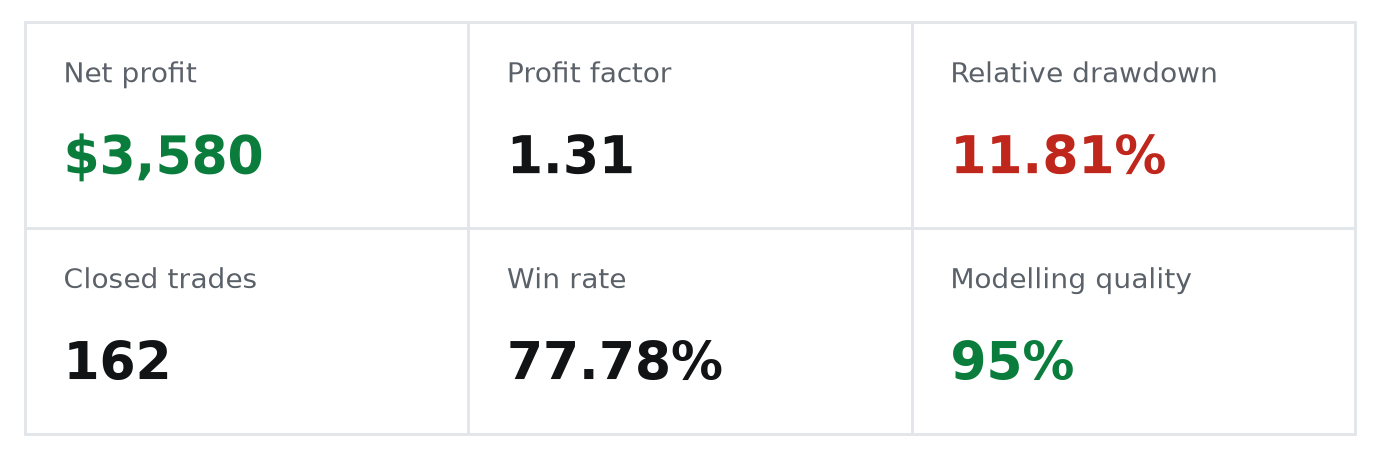
XAUUSD, M5, January 2017 to September 2026 - 110 months. Every figure here is printed by the MetaTrader 5 Strategy Tester itself, with real historical spread and $3.50 per lot per side of commission applied. Nothing is estimated and nothing is rounded in our favour.
That is $3,580.10 of net profit on a $10,000 deposit at 3% risk, from 162 closed trades, with the worst drawdown reaching 11.81% of equity and the longest losing streak running to three trades.
The full unedited report ships with the download, so you can check every line of this for yourself.
That is $3,580.10 of net profit on a $10,000 deposit at 3% risk, from 162 closed trades, with the worst drawdown reaching 11.81% of equity and the longest losing streak running to three trades.
The full unedited report ships with the download, so you can check every line of this for yourself.
The balance curve, and the part nobody shows you
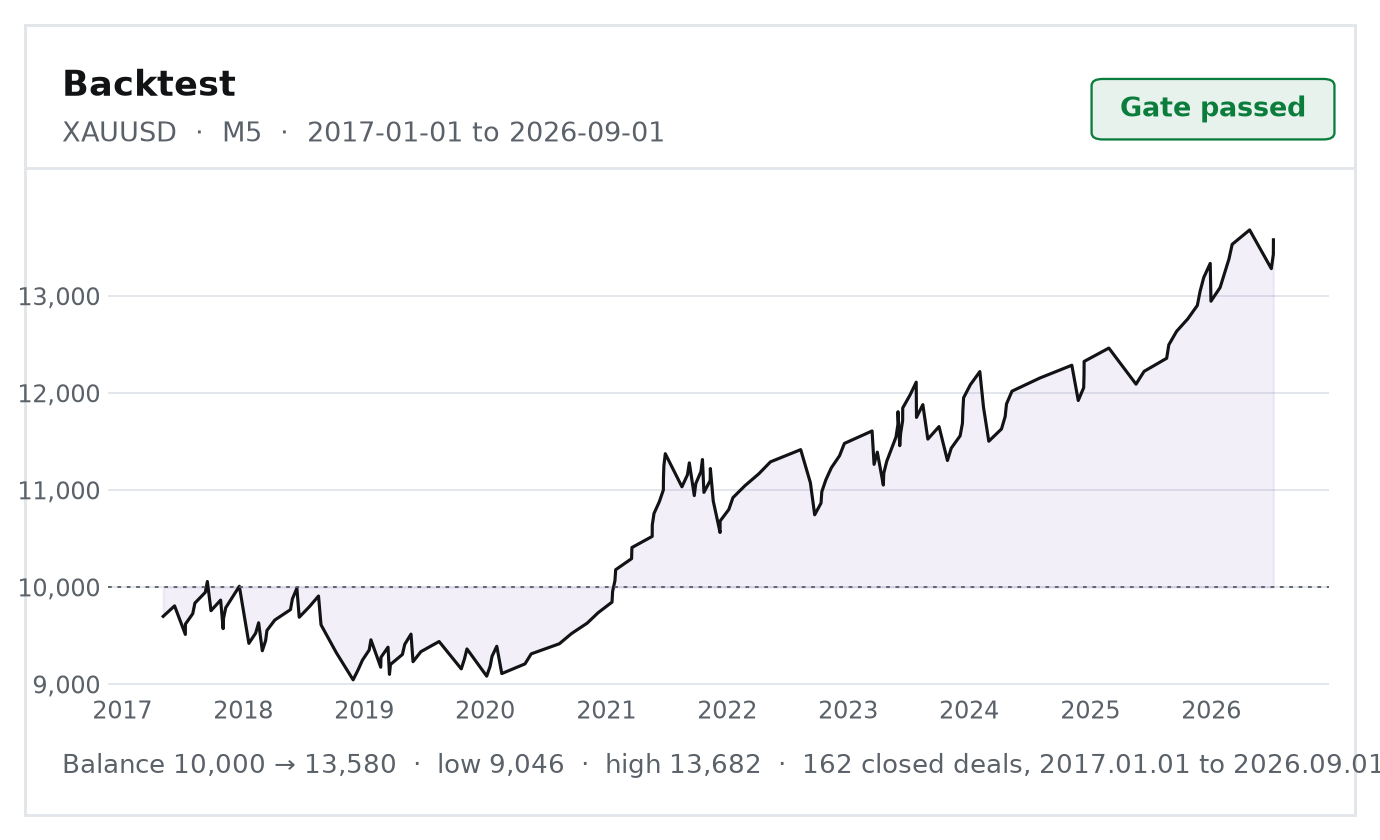
Every closed trade from that report, in order, on a $10,000 deposit at 3% risk.
Look at the first three and a half years before you decide anything. From 2017 to the middle of 2020 the account goes sideways and spends most of that time below its starting balance. That flat stretch is part of what you are buying. A patient system pays for its selectivity in time, and this is what that looks like on a chart.
Look at the first three and a half years before you decide anything. From 2017 to the middle of 2020 the account goes sideways and spends most of that time below its starting balance. That flat stretch is part of what you are buying. A patient system pays for its selectivity in time, and this is what that looks like on a chart.
It cleared the same gate as everything else on this site
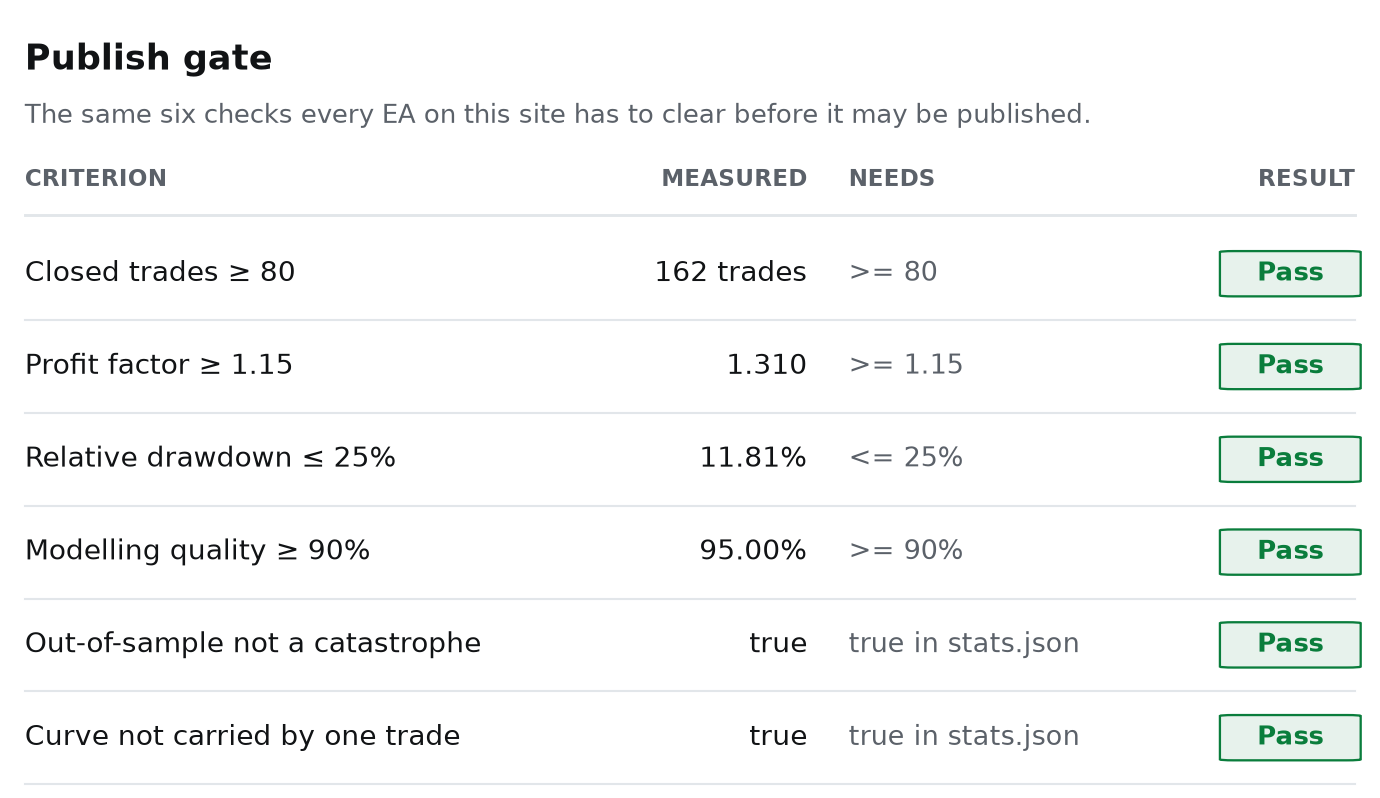
Nothing gets published here on a screenshot. Every EA on pipfixalgo.com has to clear six checks against its own raw MetaTrader 5 report before the importer will accept it, and the importer refuses the whole package if a single figure in the statistics disagrees with the report.
Ambush was put through exactly the same gate. The measured column below is read out of the report, not typed in.
Ambush was put through exactly the same gate. The measured column below is read out of the report, not typed in.
Measured the way a challenge actually works
A single backtest tells you very little about whether a challenge would pass. So the same run was re-scored as 108 separate attempts - each starting on a different month across the nine years, each one a race to +10% before losing 10%, with the 5% daily limit enforced throughout.
At 1% risk: reached the target in 46.3% of attempts, zero limits breached.
At 2% risk: 77.8% reached the target, zero breached, median 32 months.
At 3% risk (recommended): 94.4% reached the target, zero breached, median 22 months.
At 4% risk: 89.8% reached the target, 6.5% breached, median 16 months.
At 4.5% risk: 85.2% reached the target, 12.0% breached, median 14 months.
At 5% risk: 29.6% reached the target, 69.4% breached, median 4 months.
At 3% risk it did not breach a single limit in 108 attempts across nine years. That is the number worth buying it for.
The 5% row is published for completeness, not as a recommendation. It reaches the target fastest and loses the account seven times out of ten.
At 1% risk: reached the target in 46.3% of attempts, zero limits breached.
At 2% risk: 77.8% reached the target, zero breached, median 32 months.
At 3% risk (recommended): 94.4% reached the target, zero breached, median 22 months.
At 4% risk: 89.8% reached the target, 6.5% breached, median 16 months.
At 4.5% risk: 85.2% reached the target, 12.0% breached, median 14 months.
At 5% risk: 29.6% reached the target, 69.4% breached, median 4 months.
At 3% risk it did not breach a single limit in 108 attempts across nine years. That is the number worth buying it for.
The 5% row is published for completeness, not as a recommendation. It reaches the target fastest and loses the account seven times out of ten.
Why the risk setting decides everything
A prop firm fails you at 5% lost in one day, or 10% lost in total. Ambush loses about 22% of its trades, and its worst losing streak in nine years of testing was three in a row. So:
At 3% risk - three losses in a row is -9%. Still inside the limit.
At 5% risk - two losses in a row is -10%. Challenge over.
That single piece of arithmetic is why the table above looks the way it does. Set the risk to 3%.
At 3% risk - three losses in a row is -9%. Still inside the limit.
At 5% risk - two losses in a row is -10%. Challenge over.
That single piece of arithmetic is why the table above looks the way it does. Set the risk to 3%.
How an FTMO 2-Step challenge works
Phase 1: profit target 10%, maximum daily loss 5%, maximum total loss 10%, minimum 4 trading days, no time limit.
Phase 2: profit target 5%, maximum daily loss 5%, maximum total loss 10%, minimum 4 trading days, no time limit.
Funded: no profit target, maximum daily loss 5%, maximum total loss 10%.
The 5% is per day. The 10% is total. The daily figure resets at midnight CET and is measured from that day's opening balance; the total is fixed against your starting balance and never resets. You have to stay inside both, and the daily one catches people far more often.
There is no deadline on the 2-Step challenge. A slow, careful system cannot fail by being slow - only by breaching a limit. That is exactly the gap Ambush is built for.
Pass both phases and the account becomes funded: you keep a share of the profit (commonly 80-90%), the loss limits continue, and the profit target disappears. Rules vary between firms and change over time, so always read the current terms on the firm's own site before you buy a challenge.
Phase 2: profit target 5%, maximum daily loss 5%, maximum total loss 10%, minimum 4 trading days, no time limit.
Funded: no profit target, maximum daily loss 5%, maximum total loss 10%.
The 5% is per day. The 10% is total. The daily figure resets at midnight CET and is measured from that day's opening balance; the total is fixed against your starting balance and never resets. You have to stay inside both, and the daily one catches people far more often.
There is no deadline on the 2-Step challenge. A slow, careful system cannot fail by being slow - only by breaching a limit. That is exactly the gap Ambush is built for.
Pass both phases and the account becomes funded: you keep a share of the profit (commonly 80-90%), the loss limits continue, and the profit target disappears. Rules vary between firms and change over time, so always read the current terms on the firm's own site before you buy a challenge.
Running it
Platform: MetaTrader 5
Symbol and timeframe: XAUUSD, M5
Recommended risk: 3% per trade
Minimum deposit: $2,000 - any account size works, because risk is set as a percentage
VPS: recommended, because it sits waiting for limit orders to fill
No martingale. No grid. It never adds to a losing position. Every trade carries a real stop loss, and only one position is open at a time.
You receive the .ex5 expert, a .set file holding the exact tested settings, the unedited MetaTrader 5 Strategy Tester report, and a setup guide.
Symbol and timeframe: XAUUSD, M5
Recommended risk: 3% per trade
Minimum deposit: $2,000 - any account size works, because risk is set as a percentage
VPS: recommended, because it sits waiting for limit orders to fill
No martingale. No grid. It never adds to a losing position. Every trade carries a real stop loss, and only one position is open at a time.
You receive the .ex5 expert, a .set file holding the exact tested settings, the unedited MetaTrader 5 Strategy Tester report, and a setup guide.
Limitations, stated plainly
It is slow. About 18 trades a year. At 3% risk the median time to +10% in testing was 22 months. If you need a challenge passed this quarter, this is not the tool for it.
The sample is small. 162 trades over nine years is what a highly selective entry produces, but it carries less statistical weight than a system with thousands of trades.
It is specific to gold on M5. The same rule tested worse on M1, M15 and M30. Do not assume it transfers to other markets.
A backtest is not a promise. Spreads widen, news gaps happen, and no past result guarantees a future one. Trade it on a demo account first.
The sample is small. 162 trades over nine years is what a highly selective entry produces, but it carries less statistical weight than a system with thousands of trades.
It is specific to gold on M5. The same rule tested worse on M1, M15 and M30. Do not assume it transfers to other markets.
A backtest is not a promise. Spreads widen, news gaps happen, and no past result guarantees a future one. Trade it on a demo account first.

Our own funded-account record
Separately from this software, this is our own trading record with FundedNext on a $200,000 Stellar 2-Step account: challenge passed, account funded, three payouts totalling $6,356.89.
These certificates are our own results as traders. They are shown as evidence that we trade funded accounts ourselves - they are not a claim about what this EA earned. The EA's own figures are the Strategy Tester numbers above.
Phase 1 passed - 9 June 2026
These certificates are our own results as traders. They are shown as evidence that we trade funded accounts ourselves - they are not a claim about what this EA earned. The EA's own figures are the Strategy Tester numbers above.
Phase 1 passed - 9 June 2026

Account funded - 13 July 2026
FundedNext Stellar 2-Step, $200,000. Both phases cleared and the account moved to funded status.
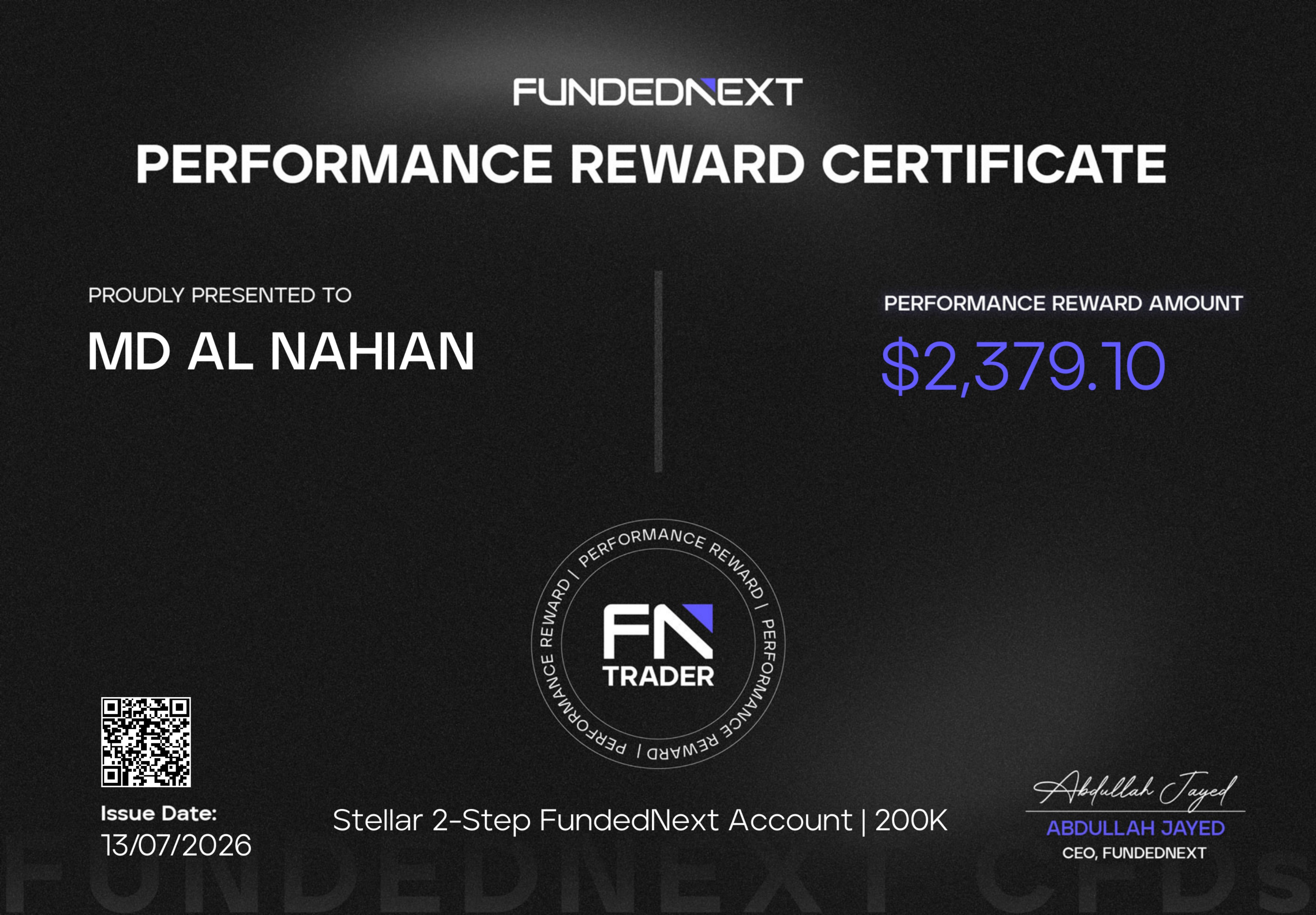
Payout - $2,379.10 - 13 July 2026
First withdrawal from the funded account.
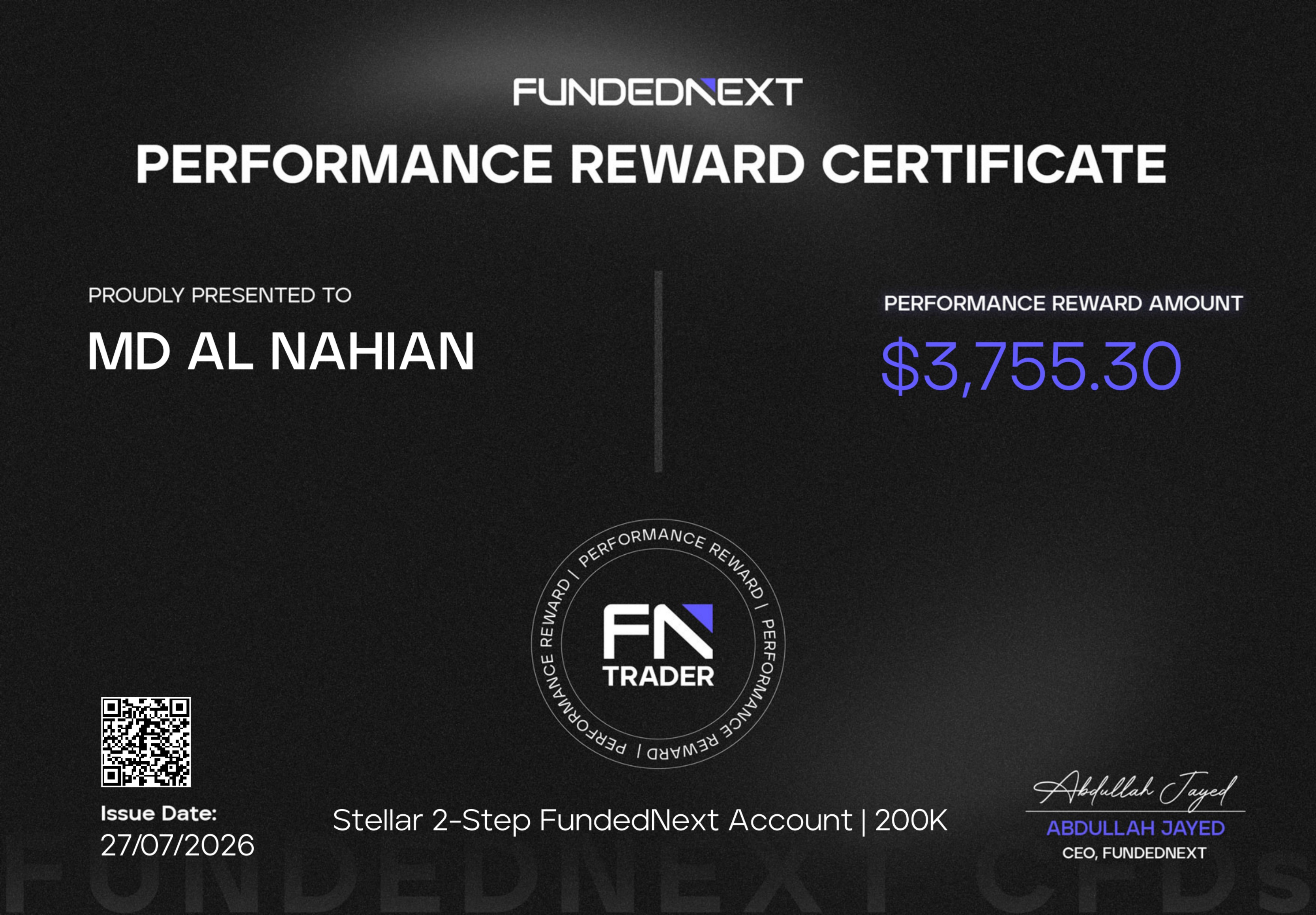
Payout - $3,755.30 - 27 July 2026
Second withdrawal. Three payouts to date total $6,356.89.